

Reactive and Component-Based Architecture

Vue.js’s core strength lies in its reactive and component-based architecture. The framework allows developers to build user interfaces that automatically update in response to changes in data. This reactivity ensures a responsive and dynamic user experience, an essential characteristic of any PWA. Vue.js leverages a virtual DOM (Document Object Model) and a fine-grained reactivity system to efficiently track changes and update the UI accordingly. This reactive nature simplifies the process of building complex user interfaces and ensures optimal performance.
Moreover, Vue.js promotes a component-based approach, where the UI is divided into reusable and modular components. This modular structure enables developers to easily manage and maintain different parts of the application, improving code organization and reusability. With Vue.js, developers can encapsulate UI logic within components, making them self-contained and promoting better code maintainability.
Vue Router for Effective Navigation
To provide a seamless navigation experience within a PWA, Vue.js offers Vue Router. This powerful routing library enables the creation of single-page applications (SPAs) with multiple views and routes. Vue Router provides a straightforward way to define routes and associate them with components, enabling navigation within the application. It supports various routing features such as dynamic routing, nested routes, and route transitions.
With Vue Router, developers can implement advanced navigation patterns like lazy loading of components, where components are loaded only when needed, reducing the initial loading time of the application. Additionally, Vue Router integrates seamlessly with Vue.js, leveraging its reactivity system to update the UI based on the current route, ensuring a smooth and intuitive navigation experience for users.
Vuex for State Management
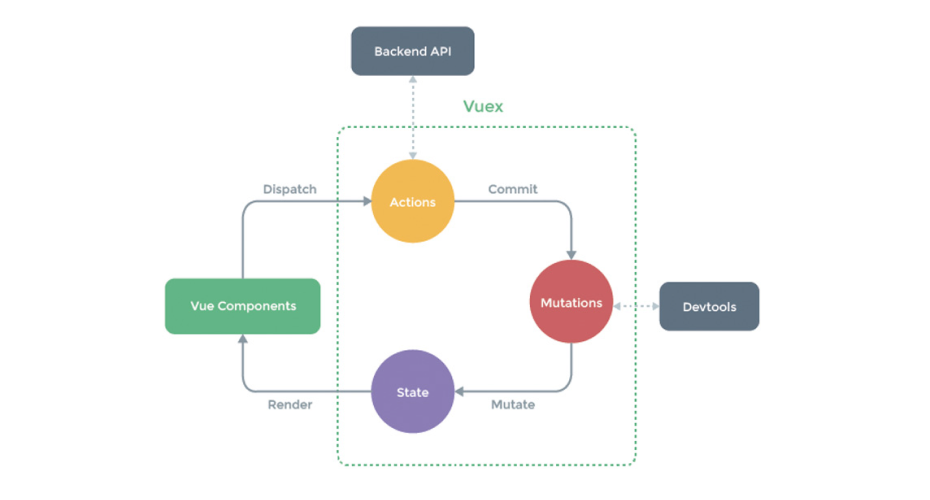
Managing application-level state is crucial for building complex PWAs. Vue.js provides Vuex, a state management pattern, and library that seamlessly integrates with the framework. Vuex offers a centralized store for managing and sharing data across different components and views, making it easier to handle data consistency, mutations, and actions within the PWA.
Vuex promotes a unidirectional data flow, where the state is stored centrally and can only be modified through explicit actions. This helps maintain a clear and predictable state management flow, enhancing code maintainability and reducing bugs caused by inconsistent state mutations. With Vuex, developers can easily organize and manage the application state, making it accessible to any component that needs it. The reactivity system of Vue.js ensures that components automatically update when the state changes, providing a consistent and synchronized user interface.
Progressive Enhancement
Vue.js aligns perfectly with the principles of progressive enhancement, a fundamental concept in the development of PWAs. With Vue.js, developers can start with a basic functionality foundation and progressively add advanced features based on the capabilities of the target devices or browsers. This incremental enhancement approach ensures broader accessibility and optimal performance across various platforms.
Vue.js supports conditional rendering, allowing developers to selectively render components or features based on browser capabilities or user preferences. By checking the availability of specific features, developers can provide alternative implementations or fallbacks, ensuring a consistent user experience across different devices and browsers. This approach promotes graceful degradation, where the application adapts to the capabilities of each user’s device while still providing core functionality.
Moreover, Vue.js’s component-based structure enables developers to create reusable and flexible components that can be easily enhanced with additional features. By separating concerns and encapsulating functionalities within components, developers can extend the application’s capabilities without compromising its core functionality or performance. This flexibility empowers developers to provide an enhanced experience for devices or browsers that support advanced features, while still ensuring a functional experience for devices with limited capabilities.
Vue CLI and PWA Plugin
Developers often rely on Vue CLI, a command-line tool, to scaffold Vue.js projects. Vue CLI includes a built-in PWA plugin that simplifies the process of transforming a Vue.js application into a full-fledged PWA. The plugin generates a service worker, a critical component for implementing features such as offline caching, background synchronization, and push notifications.
The Vue CLI PWA plugin automates the creation of the necessary configuration files and assets required for PWAs. It sets up a service worker that acts as a proxy between the application and the network, enabling offline caching of assets, including HTML, CSS, JavaScript, and other resources. This caching mechanism allows users to access the PWA even when offline or with a poor network connection, significantly improving the user experience.
Additionally, the PWA plugin provides built-in support for features like background synchronization, enabling the application to sync data with the server when the network connection is restored. It also simplifies the implementation of push notifications, allowing developers to send notifications to users even when the PWA is not actively open in their browser. By integrating these features into the development workflow, Vue.js and the PWA plugin streamline the process of building PWAs with essential capabilities, enhancing user engagement and retention.
Thriving Vue.js Ecosystem: Vue.js benefits from a vibrant and extensive ecosystem of plugins and libraries, which further enhances its capabilities for building PWAs. Libraries like Vuetify and Quasar Framework provide pre-built components and UI elements that adhere to Material Design guidelines. These libraries speed up development and ensure visually appealing and consistent user interfaces across different devices.
Vuetify, for example, offers a comprehensive set of ready-to-use components and themes that follow Material Design principles. With Vuetify, developers can quickly build visually stunning PWAs that are responsive and mobile-friendly. Similarly, the Quasar Framework provides a wide range of components, icons, and utilities, enabling developers to build performant PWAs with native-like user experiences across platforms.
These libraries integrate seamlessly with Vue.js, allowing developers to leverage their features and functionalities without sacrificing the reactivity and component-based advantages of Vue.js. By utilizing the rich ecosystem of Vue.js libraries and plugins, developers can accelerate development, improve code quality, and deliver exceptional PWAs with ease.
Concluding
Vue.js plays a vital role in the development of Progressive Web Applications (PWAs), providing developers with a powerful framework that enables reactivity, component-based architecture, and efficient state management. With its reactive and component-based architecture, Vue.js empowers developers to create dynamic and responsive user interfaces. Vue Router simplifies navigation within PWAs, while Vuex ensures effective state management. The progressive enhancement approach supported by Vue.js enables developers to build PWAs that cater to a broad range of devices and browsers. The Vue CLI and the PWA plugin automate the creation of essential PWA features, such as offline caching and push notifications. Lastly, the thriving Vue.js ecosystem offers a variety of libraries and plugins that enhance the development process and enable the creation of visually stunning PWAs. With Vue.js, developers can build robust and feature-rich PWAs that provide an immersive and engaging user experience across various platforms.

Don't want to miss anything?
Get weekly updates on the newest design stories, case studies and tips right in your mailbox.
